1. 先查詢是否被Lock
SELECT
b.SID,
b.USERNAME,
b.MACHINE,
b.SERIAL#
FROM
V$ACCESS a,
V$SESSION b
WHERE
a.SID = b.SID
AND a.OBJECT = '%PACKAGE_NAME%'
AND a.TYPE = 'PACKAGE';
2. 若是被Lock, 砍掉該筆session
alter system kill session 'sid,serial#'
1. 先查詢是否被Lock
SELECT
b.SID,
b.USERNAME,
b.MACHINE,
b.SERIAL#
FROM
V$ACCESS a,
V$SESSION b
WHERE
a.SID = b.SID
AND a.OBJECT = '%PACKAGE_NAME%'
AND a.TYPE = 'PACKAGE';
2. 若是被Lock, 砍掉該筆session
alter system kill session 'sid,serial#'
Useful query to get user id, responsibility id and application id in EBS.
To know about User Id use below Query:-
SQL> select user_id from fnd_user where user_name=’DOYEN’;
To know about Responsibility id use below Query:-
SQL> select responsibility_id,RESPONSIBILITY_NAME from fnd_responsibility_vl where responsibility_name like ‘%India%Local%Payables%’;
To Know about Application id use below Query:-
https://doyensys.com/blogs/useful-query-to-get-user-id-responsibility-id-and-application-id-in-ebs/
SQL>select APPLICATION_ID from fnd_responsibility_vl where responsibility_id=50366;
To Know about Org id from po:-
SQL>select org_id from po_headers_all where segment1=’&PO’;
To know about Requisition Org id from requisition number:-
$SQL>select hr.name, prh.segment1, prh.org_id from po_requisition_headers_all prh, hr_all_organization_units hr where prh.org_id = hr.organization_id and prh.segment1 = ‘&Enter_Req_Number’;
SELECT DISTINCT
fa.APPLICATION_SHORT_NAME, --application(模組)
fat.APPLICATION_NAME,
fcp.CONCURRENT_PROGRAM_NAME, --program(應用程式)
fcpt.USER_CONCURRENT_PROGRAM_NAME,
fcpT.DESCRIPTION,
fcpt.LANGUAGE
FROM apps.fnd_application_tl fat,
apps.fnd_application fa,
apps.fnd_concurrent_programs_tl fcpt,
apps.fnd_concurrent_programs fcp,
apps.fnd_executables fe
WHERE fat.APPLICATION_ID = fa.APPLICATION_ID
AND fat.LANGUAGE = fcpt.LANGUAGE
AND fa.APPLICATION_ID = fcp.APPLICATION_ID
AND fcpt.CONCURRENT_PROGRAM_ID = fcp.CONCURRENT_PROGRAM_ID
AND fcp.executable_id = fe.executable_id
AND fcpt.USER_CONCURRENT_PROGRAM_NAME='HUB flow concurrent';
--報表名稱
SELECT
distinct user_concurrent_program_name,
responsibility_name,
request_date,
argument_text,
request_id,
phase_code,
status_code,
logfile_name,
outfile_name,
output_file_type,
hold_flag,
user_name
FROM
apps.fnd_concurrent_requests fcr,
apps.fnd_concurrent_programs_tl fcp,
apps.fnd_responsibility_tl fr,
apps.fnd_user fu
WHERE
fcr.CONCURRENT_PROGRAM_ID = fcp.concurrent_program_id
and fcr.responsibility_id = fr.responsibility_id
and fcr.requested_by = fu.user_id
--and user_name = upper('HIMSINGH')
and user_concurrent_program_name in ('deliverry flow concurrent')
--and Phase_code='P'
ORDER BY REQUEST_DATE DESC;
--查看request執行狀況
SELECT /*+ rule */
rq.parent_request_id,
rq.request_id,
tl.user_concurrent_program_name,
rq.actual_start_date,
rq.actual_completion_date,
ROUND((rq.actual_completion_date - rq.actual_start_date) * 1440, 2) run_time_min
FROM apps.fnd_concurrent_programs_vl tl,
apps.fnd_concurrent_requests rq
WHERE tl.application_id = rq.program_application_id
AND tl.concurrent_program_id = rq.concurrent_program_id
AND rq.actual_start_date IS NOT NULL
AND rq.actual_completion_date IS NOT NULL
AND tl.user_concurrent_program_name = 'employee master data'
ORDER BY rq.actual_completion_date DESC;
1. 查看要設定的畫面Title是什麼, 請參考另一篇: [EBS]查詢某個畫面的彈性欄位
2.切換權限Application Developer", Flexfield > Descriptive > Register
按[Segments] > [New], 編輯相關欄位
退出時,check [Freeze Fexfild definitions],並[Compile]


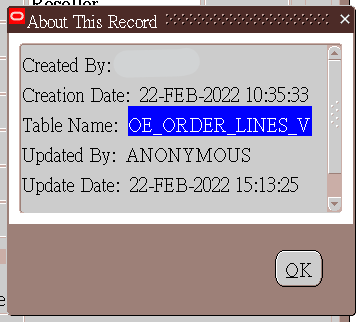
1. Situation: 想查詢訂單明細的彈性欄位:SKU ID



APEX DB 透過DB LINK呼叫EBS Package,
出現幾個怪現象:
1.
ERROR at line 1:
ORA-04068: existing state of packages has been discarded
ORA-04061: existing state of package body "PACKAGE.NAME" has been
invalidated
ORA-06508: PL/SQL: could not find program unit being called:
"PACKAGE.NAME"
ORA-06512: at line 1
2. EBS Package 裡有使用 fnd_global.org_id, fnd_global.user_id, FND_PROFILE.VALUE('GL_SET_OF_BKS_ID')
所以APEX DB執行前會去set_client_info, fnd_global.apps_initialize.
但執行EBS package 寫入EBS table卻出現別人的user_id & org_id.
--------------------------------------------------------------------------------------------------------
先是懷疑DB Link的session, 查到這篇說明
https://stackoverflow.com/questions/1761595/frequent-error-in-oracle-ora-04068-existing-state-of-packages-has-been-discarde
關鍵字:
ALTER SESSION CLOSE DATABASE LINK DBLINK
PRAGMA SERIALLY_REUSABLE
---------------------------------------------------------------------------------------------------------
ALTER SESSION CLOSE DATABASE LINK DBLINK:
https://www.uj5u.com/shujuku/28126.html
說明一般企業不使用DB Link原因:不外乎出問題不好查..佔資源...
那如果真的要使用, 該如何管理DB Link Session?
文中有三種方式, 個人認為1和3比較適合, 1為首選
1. 使用完後程式commit, close db link (沒有commit會出現ora-02080錯誤)
指令:
commit;
alter sesssion close database link ;
or 系統包:
DBMS_SESSION.CLOSE_DATABASE_LINK(dblink_name);
EXAMPLE:
DECLARE
v VARCHAR2(50);
CURSOR r IS
SELECT name FROM employee@test_db_link WHERE empno = '1';
BEGIN
OPEN r;
LOOP
FETCH r INTO v;
EXIT WHEN r%NOTFOUND;
END LOOP;
CLOSE r;
COMMIT;
EXECUTE IMMEDIATE 'alter session close database link test_db_link';
END;
3.定期JOB Kill session
select sid,
serial#,
username,
osuser,
machine,
'alter system kill session ' || '''' || sid || ',' || serial# ||''' immediate;' session_level
from v$session
where machine in ('連線的DB machine1', '連線的DB machine2', '連線的DB machine3');
命令後面要加immediate, 沒加的話v$session中的STATUS列會變為KILLED,但是資源並未釋放
利用方式三可以做成JOB定時kill session,但這樣存在很大的風險。 ==> 可能不小心刪到還在使用的session?? 而且我們沒有EBS DB權限
---------------------------------------------------------------------------------------------------------
PRAGMA SERIALLY_REUSABLE
https://blog.csdn.net/xiadingling/article/details/82492709
"Packaged public variables and cursors persist for the duration of a session.
They can be shared by all subprograms that execute in the environment.
They let you maintain data across transactions without storing it in the database."
Package裡的變數生命週期是會話(session), 所以如果在同一session執行多次 變數可能會使用到上一次執行的值.
PRAGMA SERIALLY_REUSABLE這命令使得Oracle只保持一次呼叫的值.
使用時Package & Package Body都要宣告.
缺點:每次使用都會釋放, 也因此會占用DB內存, 依照使用次數成長, 與登錄用戶數無關, 會大量使用到內存
Ajax Callback: 呼叫DB Funcction取得值
Process_name=set_clock_in
declare
v_clock_in varchar2(20);
begin
SELECT get_clock_in_fun( to_char(sysdate,'yyyy-mm-dd'))
into v_clock_in
from dual;
htp.p(v_clock_in);
end;
Javascript: AJAX Call API
apex.server.process("set_clock_in" //Process or AJAX Callback name
, null //Parameter
, {
success: function(pData){
apex.item("P1_CLOCK_IN").setValue(pData);
//alert('Record loaded successfully');
},
dataType: "text"
}
);
PLSQL Call API Function:
get_clock_in_fun
CREATE OR REPLACE function get_clock_in_fun( v_date IN varchar2)
return varchar2
is
-- Local variables here
i integer;
l_resp clob;
g_url varchar2(300) := 'https://example-api.company.com/clock-in/v_date;
v_hashkey varchar2(128) := '.........................................................................';
v_hashdate varchar2(20);
v_token varchar2(200);
v_resp varchar2(4000);
web_failure_detected EXCEPTION;
PRAGMA EXCEPTION_INIT(web_failure_detected, -29273);
begin
--Authorization : {Hash Key}:{UTC datetime}
select to_char(systimestamp at time zone 'UTC','yyyymmddhh24miss')
into v_hashdate
from dual;
select utl_raw.cast_to_varchar2(utl_encode.base64_encode(utl_raw.cast_to_raw(v_hashkey||':'||v_hashdate)))
into v_token
from dual;
--utl_encode.base64_encode()編碼生成的字串以64個字元為一組其後添加回車換行字元
--利用正則式替換掉所有空白字元,不管是否為回車換行字元
v_token:=regexp_replace(v_token, '\s', '');
apex_web_service.g_request_headers(1).name := 'Authorization';
apex_web_service.g_request_headers(1).value := 'Bearer '||v_token;
-- Content-Type
apex_web_service.g_request_headers(2).name := 'Content-Type';
apex_web_service.g_request_headers(2).Value := 'text/html';
--HTTP 411 header加入Content-Length
apex_web_service.g_request_headers(3).name := 'Content-Length';
apex_web_service.g_request_headers(3).value := 0;
l_resp := apex_web_service.make_rest_request(p_url => g_url,
p_http_method => 'GET'
--p_parm_name => apex_util.string_to_table('',':'),
--p_parm_value => apex_util.string_to_table('',':')
--p_wallet_path =>null,
--p_wallet_pwd => null
);
v_resp := substr(l_resp, 1, 4000);
with date_array (col) as
(select v_resp
from dual)
SELECT min(val) INTO v_resp FROM
(
select regexp_substr(replace(substr(col,instr(col,'[')+1, instr(col,']')-2), '"', ''), '[^,]+', 1, level) val
from date_array
connect by level <= regexp_count(col, ',') + 1
);
return v_resp;
EXCEPTION
WHEN web_failure_detected THEN
DBMS_OUTPUT.put_line ('web failure detected');
RETURN ':';
WHEN OTHERS THEN
RETURN '--';
END;
